Views: 85 Author: Site Editor Publish Time: 2026-10-19 Origin: Site
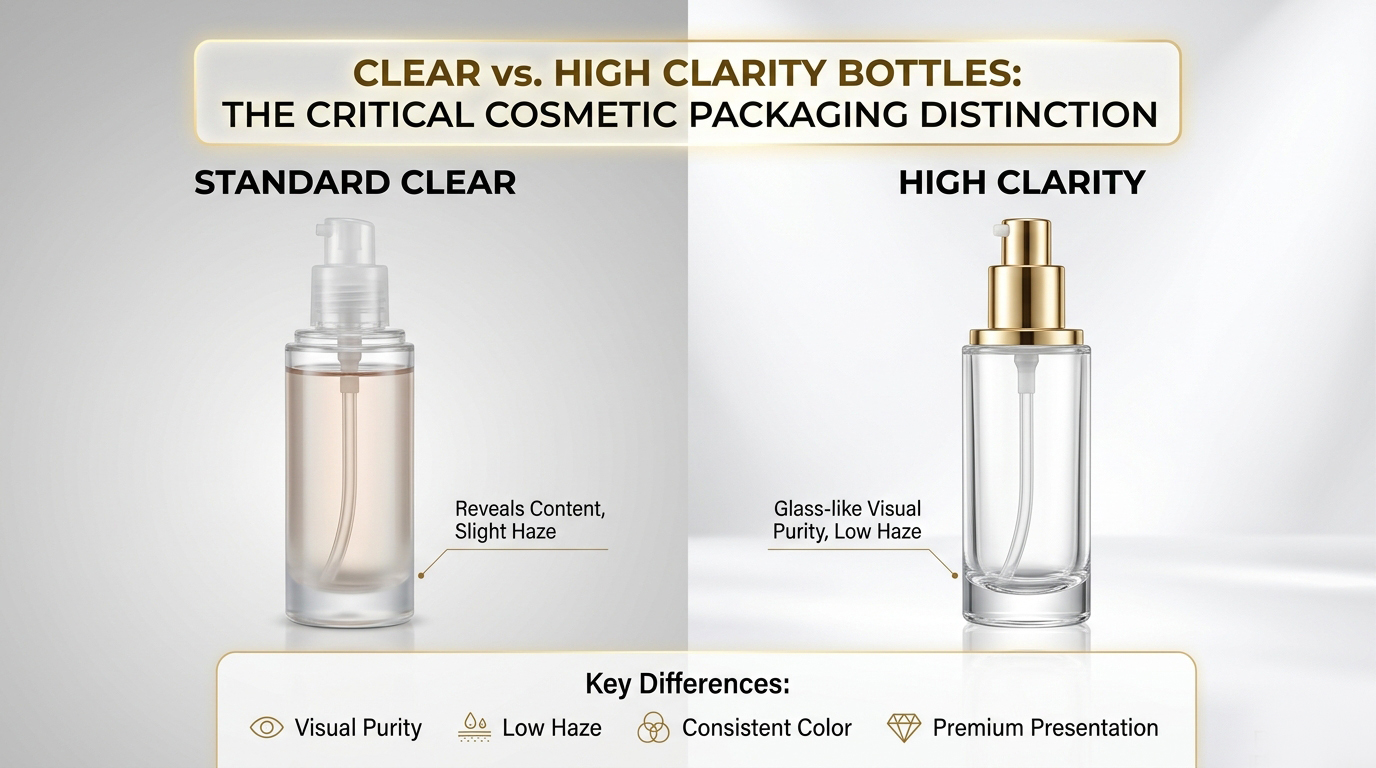
When choosing plastic bottles for skincare and beauty products, buyers often tell packaging suppliers, “We need a clear bottle” or “We want a high-clarity finish.”
But are clear and high-clarity cosmetic bottles actually the same?
Not necessarily. Both may allow consumers to see the product inside, but the expected appearance can be quite different.
Understanding this distinction helps brands select suitable packaging materials, establish realistic quality standards, and avoid misunderstandings during sampling and mass production.
In general, a clear cosmetic bottle is transparent enough for consumers to see the product inside.
Rather than having a solid, opaque color, the bottle allows light to pass through and reveals the formula's color and appearance.
Materials commonly used for transparent cosmetic packaging include PET, PETG, AS, and acrylic, depending on the bottle design and application.
However, transparency alone does not guarantee a perfectly clear appearance.
A bottle may allow the contents to be seen while still exhibiting some haze, a slight color tint, or variations in clarity across different sections.
For example, a thin-walled bottle may look relatively clear, while its thick base appears slightly gray or cloudy. A bottle may also show differences in appearance around the shoulders, corners, or curved surfaces.
High clarity is a more demanding visual requirement.
Beyond basic transparency, buyers may expect the bottle to have:
A clean, glass-like appearance
Low visible haze
Minimal noticeable particles or black specks
Consistent color throughout the bottle
Clear-looking thick bases and corners
Minimal visible flow marks or stress-related whitening
Consistent appearance across production batches
These expectations are particularly relevant to premium skincare packaging, thick-wall bottles, heavy-base containers, and designs intended to showcase the formula.
Bottle thickness can make optical imperfections more noticeable. Light travels through more material in thick sections, so slight variations in color, haze, or material uniformity may become easier to see.
A bottle that looks clear along its sidewall may not maintain the same appearance through its base or shoulder.
For brands seeking a refined, glass-like effect, high clarity should therefore be treated as a defined appearance requirement rather than simply another way to say transparent.
The material name alone does not determine the final clarity of a cosmetic bottle.
Two bottles made from the same polymer can look different because of differences in raw material grade, processing conditions, mold quality, bottle geometry, and quality control.
Several factors deserve attention.
Different grades of the same material may have different optical properties. Material selection should match the required clarity, mechanical performance, and intended application.
For processes and materials that require drying, inadequate moisture control may contribute to processing defects and reduced visual quality.
The appropriate drying requirements depend on the specific resin and manufacturing process.
For bottle designs made through preform-based or extrusion-based blow molding, the quality and uniformity of the starting material can affect the finished appearance.
Visible flow patterns or thickness variations may become more apparent after forming.
Injection temperature, blow-molding conditions, cooling, and other process parameters influence how the material forms.
Conditions that are not properly controlled may contribute to haze, uneven appearance, or localized defects.
The mold surface can influence the finish of the molded bottle. Mold polishing and maintenance are particularly relevant when a smooth, high-clarity appearance is required.
Thick bases, sharp transitions, pronounced shoulders, and complex curves can make uniform material distribution more challenging.
In some designs, stretching and localized stress during forming may also contribute to visible whitening or other appearance defects.
These factors interact with one another. High clarity is therefore the result of suitable material selection, appropriate tooling and processing, and consistent inspection—not simply a material label.
A standard clear bottle and a high-clarity bottle may use similar base materials but require different appearance standards and production controls.
For a standard clear bottle, the primary requirement may be that the product inside remains visible.
A high-clarity specification may place additional emphasis on minimizing visible defects and maintaining a more uniform appearance across the entire container.
Depending on the design, additional requirements may include:
Tighter visual inspection criteria
Better control of haze and color variation
More attention to thick-base clarity
Improved control of wall thickness and forming conditions
Additional sample reviews and production checks
More demanding mold finishing requirements
If a design also features thick walls, a heavy base, or complex contours, achieving the desired appearance may require further development and process adjustments.
This does not mean every high-clarity bottle must be expensive. The cost depends on the material, design, manufacturing process, order quantity, and required quality standard.
The important point is that the price difference may reflect a difference in appearance requirements and quality control, not just the bottle's material.
When comparing supplier quotations, brands should confirm that the quoted products are being evaluated against equivalent clarity standards.
Material selection should account for both optical appearance and the functional requirements of the packaging.
| Material | General appearance and considerations |
PET | Commonly used for transparent cosmetic bottles; suitable grades and designs can provide good clarity |
PETG | Often selected for transparent packaging with complex shapes or a premium visual presentation |
AS | Can provide a clear, rigid appearance, subject to the grade and product requirements |
Acrylic (PMMA) | Often used for premium-looking containers and components where optical appearance is important |
PP | Can be manufactured in translucent or transparent grades, but the result differs by grade and design |
PE | Frequently used for flexible or squeezable packaging and often has a more translucent or opaque appearance |
These are general material characteristics, not guarantees of the appearance of every finished container.
PE and PP are not automatically unsuitable for transparent packaging, just as PET, PETG, AS, or acrylic do not automatically guarantee high clarity. The specific grade, forming process, bottle geometry, and quality requirements all matter.
Material selection should also consider chemical compatibility with the formula, impact resistance, weight, cost, recyclability considerations, and compatibility with the filling and dispensing system.
For brands seeking a rigid, transparent bottle with a glass-like visual effect, PET, PETG, AS, and acrylic may be worth evaluating. The best choice depends on the product and the intended packaging design.
High clarity is difficult to judge accurately from photographs alone.
Lighting, background color, camera settings, image processing, and screen quality can all affect how transparent a bottle appears online.
For this reason, physical samples should be reviewed before the appearance specification is finalized.
Observe the bottle under natural or neutral lighting to assess its overall clarity, tint, and visible surface defects.
A white background can help reveal grayness, yellow or blue tint, and differences in haze.
Inspect the base separately from the sidewall. Look for cloudy areas, uneven color, or visible imperfections.
Curved transitions and corners may show differences in thickness or appearance that are less noticeable on flat surfaces.
Filling the bottle with water can provide an initial visual reference, but it does not replace testing with the actual formula.
The color, opacity, viscosity, and refractive properties of the product can change the final appearance.
Review several units together to identify visible differences in clarity, color, and finish.
Where appearance consistency is critical, agree on an approved reference sample and define acceptable visual variation before mass production.
The phrase “high clarity” can mean different things to different buyers and suppliers. Clear communication helps turn a subjective preference into a more practical specification.
If basic transparency is sufficient, you might specify:
The contents should be visible through the bottle.
A standard clear finish is acceptable.
A glass-like appearance is not required.
If a premium, high-clarity appearance is important, consider specifying:
Low visible haze
Minimal noticeable gray, yellow, or blue tint
Clear-looking thick bases and corners
No obvious black specks or visible contamination
Minimal visible stress whitening or flow marks
Consistent appearance across production units
Physical sample approval before mass production
These requirements should be adjusted to the actual material, bottle design, and manufacturing capabilities.
For particularly demanding projects, brands and suppliers can establish agreed inspection conditions and defect acceptance criteria rather than relying on subjective descriptions alone.
The clearer the specification, the easier it is to evaluate samples and align expectations before production begins.
Clear and high-clarity cosmetic bottles both allow consumers to see the product inside, but they represent different levels of visual expectation.
A standard clear bottle focuses on basic transparency. A high-clarity bottle requires greater attention to optical cleanliness, haze, color consistency, wall thickness, and the appearance of areas such as the base and shoulders.
For brands developing premium skincare packaging, the right approach is to define the desired appearance early, select a suitable material, and confirm the result through physical samples.
At BEYAQI, we understand that cosmetic packaging must meet both functional requirements and brand expectations. By evaluating material options, bottle design, surface appearance, and production quality together, brands can make more informed decisions when developing transparent and high-clarity cosmetic packaging.


 English


