Views: 22 Author: Site Editor Publish Time: 2026-11-13 Origin: Site
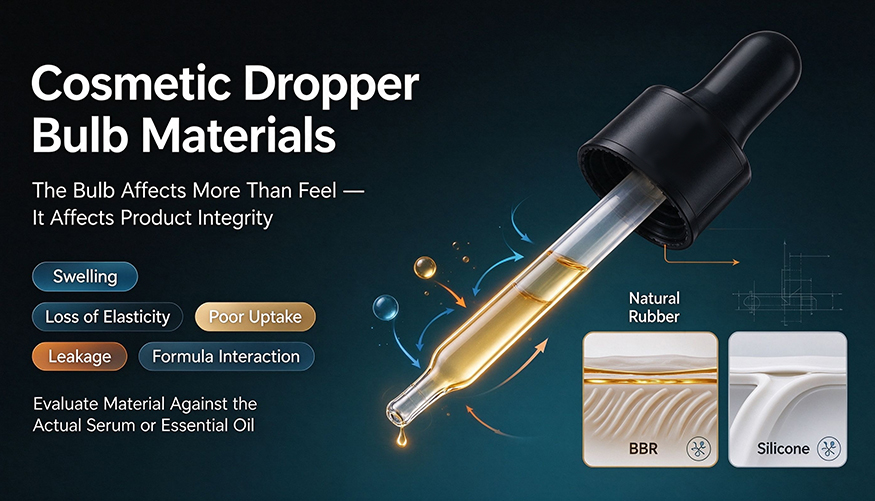
When selecting packaging for facial serums and essential oils, brands often focus on the glass bottle: Is it borosilicate glass? Does its amber color help protect light-sensitive ingredients? But one small component deserves just as much attention: the dropper bulb.
As the flexible part of a dropper assembly, the bulb compresses and rebounds to draw liquid into the pipette and dispense it. If its material is incompatible with the formula, the result may include swelling, loss of elasticity, poor liquid uptake, leakage, or unwanted interactions between the packaging and the product.
For cosmetic brands, choosing the right cosmetic dropper bulb material is not simply about softness. It is about chemical compatibility, dispensing performance, sealing reliability, and product integrity throughout the intended shelf life.
Different elastomers offer different combinations of flexibility, chemical resistance, processability, and cost. No single material is suitable for every cosmetic formula.
Natural rubber is known for its elasticity and familiar soft-touch feel. It can be a cost-effective option for conventional dropper applications.
However, natural rubber may have limited compatibility with certain oils and solvents. Its performance depends on the rubber formulation, additives, and exposure conditions. Natural rubber latex proteins can also trigger allergic reactions in susceptible individuals.
Best considered for: Applications where the formula is compatible with the specific rubber grade and latex-related requirements have been evaluated.
Key consideration: Do not assume that a natural rubber bulb is suitable for essential oils, alcohol-rich formulas, or long-term contact with an active serum without testing.
Silicone is widely used in premium cosmetic packaging because of its flexibility, smooth feel, and generally good resistance to many cosmetic ingredients. It can provide consistent compression and recovery when properly specified.
Nevertheless, silicone is not universally compatible with every formula. Some ingredients may diffuse into or permeate through certain silicone formulations, while the bulb's mechanical properties and extractables profile can vary by grade.
Best considered for: Premium serums and skincare products where a soft touch, reliable recovery, and suitable chemical compatibility are priorities.
Key consideration: Evaluate the exact silicone grade against the finished formula, particularly when essential oils, fragrances, or high levels of volatile solvents are present.
Thermoplastic elastomers combine rubber-like flexibility with thermoplastic processing characteristics. Depending on the formulation, TPE can offer good elastic recovery and may provide an alternative to conventional rubber materials.
Some medical-grade TPE compounds are specifically developed for applications requiring controlled formulation and low extractables. For example, Teknor Apex describes its Medalist® MD-12344 grade as a dropper-bulb material with resistance to acids, bases, and solvents, along with specified biocompatibility and regulatory-related attributes. These claims apply to the particular grade, not to every TPE formulation.
Best considered for: Cosmetic and personal care packaging where a latex-free alternative, controlled material formulation, and consistent dispensing performance are important.
Key consideration: TPE is a broad material family. Confirm the exact grade, its compatibility with the formula, and its performance under the intended storage conditions.
Nitrile rubber is often selected for its resistance to oils and many hydrocarbons. Depending on the formulation, it may perform well in applications where oil resistance is a key requirement.
However, resistance to one oil or solvent does not establish compatibility with every essential oil blend. Essential oils can contain different combinations of chemical compounds, and the finished product may also include alcohol, fragrance ingredients, or other solvents.
Best considered for: Selected oil-containing formulations where the specific NBR compound has demonstrated compatibility.
Key consideration: Test the complete formula rather than relying on the general description of NBR as an oil-resistant material.
PVC can be formulated to provide flexibility, but flexible PVC may rely on plasticizers and other additives. Depending on the formulation and conditions, the migration of certain substances may become a concern.
For cosmetic dropper bulbs, the relevant question is not simply whether the material is PVC. Buyers should understand the exact compound, additive package, applicable regulatory requirements, and evidence supporting its intended use.
Best considered for: Only applications where the specific PVC formulation has been appropriately assessed and meets the product's requirements.
Key consideration: Where migration, ingredient interaction, or a preference for plasticizer-free materials is a concern, evaluate alternative materials and request supporting documentation.
| Material | Potential advantages | Main considerations |
Natural rubber | High elasticity; economical options | Latex allergy concerns; limited compatibility with some oils and solvents |
Silicone | Soft feel; good resistance to many ingredients | Grade-specific compatibility; permeability and extractables require evaluation |
TPE | Thermoplastic processing; latex-free grades available | Properties vary considerably by formulation |
NBR | Good resistance to many oils and hydrocarbons | Not compatible with every essential oil or solvent blend |
PVC | Flexible formulations; established processing methods | Additives and potential migration require assessment |
This comparison is a starting point for material selection, not a substitute for compatibility testing. Final performance depends on the specific compound, formula, contact conditions, and complete dropper design.
A formula containing essential oils, vitamin C derivatives, alcohol, or fragrance ingredients may place different demands on packaging components. The best approach is to assess the formula and packaging together.
Do not evaluate a dropper bulb based on one headline ingredient alone. Consider the full ingredient list, ingredient concentrations, pH where relevant, and the potential effects of solvents, fragrances, and oils.
The bulb must compress comfortably and recover sufficiently to draw liquid into the pipette. Changes in elasticity can affect dispensing consistency and the user experience.
Testing should assess liquid uptake, repeatable dispensing, visible deformation, and changes after storage.
Leakage can result from several factors, including the bulb material, cap design, inner seal, neck finish, and assembly tolerances. Selecting a chemically compatible bulb does not automatically make the complete dropper leakproof.
Test the assembled package under relevant storage, transport, and orientation conditions.
For brands with strict quality or regulatory requirements, request documentation for the exact material grade. Depending on the application, useful information may include composition declarations, extractables or migration data, chemical-resistance information, and relevant compliance statements.
Medical-grade designations alone do not establish that a material is suitable for every cosmetic formula.
A practical validation program can include:
Visual inspection: Check for discoloration, surface changes, tackiness, cracking, or deformation.
Mechanical evaluation: Assess compression, elastic recovery, and dispensing consistency.
Leak testing: Check the complete assembled package under defined test conditions.
Formula compatibility: Monitor the bulb and product for changes during suitable storage studies.
Shelf-life assessment: Evaluate performance over the intended storage period, using an appropriate test protocol.
Accelerated testing can help identify potential problems, but it should not automatically be treated as equivalent to a specific number of years of real-time storage.
There is no universal service-life figure that applies to all cosmetic dropper bulbs. Claims that natural rubber always lasts only 6–12 months, or that silicone and TPE always last several years, are too broad without specifying the material grade, formula, storage environment, and usage conditions.
For a sealed cosmetic product, the relevant question is whether the bulb maintains its required properties throughout the product's intended shelf life. After opening, repeated compression, exposure to air, formula contact, and storage conditions may influence performance.
Instead of relying on a generic lifespan estimate, brands should validate the complete packaging system using the actual formula and intended conditions of use.
At BEYAQI, cosmetic packaging selection involves more than matching a glass bottle with a visually appealing dropper. Bulb material, pipette design, closure components, formula characteristics, and dispensing requirements all need to work together.
For brands developing facial serums, facial oils, and other dropper-packaged products, evaluating these factors early can help reduce compatibility issues and improve packaging reliability before mass production.
When requesting a dropper packaging solution, share the product's main ingredients, viscosity, expected shelf life, and any special requirements for oil or solvent resistance. These details help establish a more suitable starting point for material selection and validation.
There is no universal best material for all essential oils. Silicone, NBR, and selected TPE compounds may be options, depending on the formulation. Test the exact essential oil blend against the proposed material before finalizing the packaging.
Not in every application. TPE offers thermoplastic processing advantages and is available in latex-free formulations. Silicone can offer excellent flexibility and resistance to many ingredients. The better option depends on chemical compatibility, mechanical performance, extractables requirements, manufacturing needs, and cost.
Potentially, if the specific rubber compound is compatible with the formula and meets the product's requirements. However, latex-related allergy concerns and potential interactions with oils or solvents should be considered.
Start by selecting a compatible material grade, then validate the complete package with the actual formula. Check for swelling, tackiness, cracking, and loss of elastic recovery during storage and dispensing tests. Do not assume that changing the bulb material alone will resolve every leakage or dispensing issue.
Provide the formula's main ingredients, viscosity, intended shelf life, target dispensing volume, bottle and pipette requirements, and any relevant compliance specifications. If the product contains essential oils, alcohol, or other solvents, identify them early so material compatibility can be evaluated.
Choosing the right cosmetic dropper bulb means looking beyond softness and appearance. By evaluating material properties, formula compatibility, and complete-package performance together, brands can make more informed decisions about serum and essential oil packaging.


 English


