Views: 48 Author: Site Editor Publish Time: 2026-10-28 Origin: Site
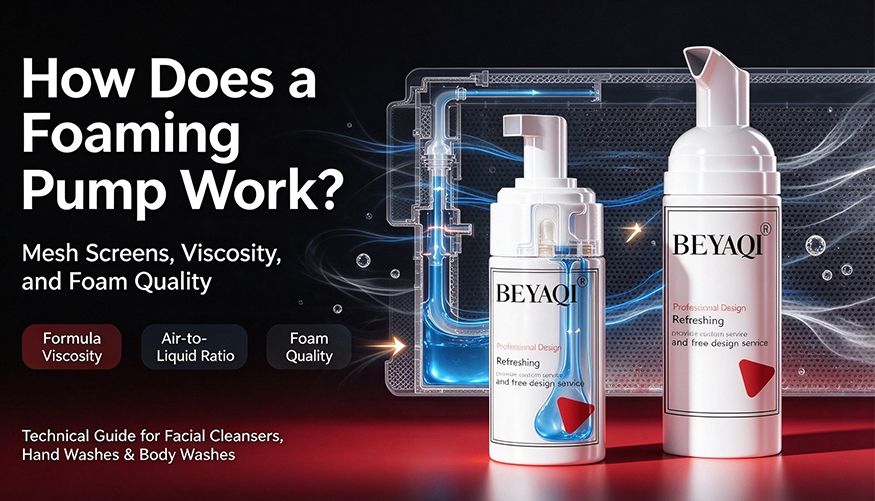
A foaming pump may look like a regular lotion pump with a different actuator, but the mechanism inside is quite different.
The key component is the mesh screen, which helps transform liquid soap or cleanser into foam by mixing the formula with air and breaking the mixture into smaller bubbles.
For cosmetic brands, understanding how a foaming pump works is important when selecting packaging for facial cleansers, hand washes, body washes, and other foam-based products. Formula viscosity, air-to-liquid ratio, mesh design, and pump performance can all affect the dispensing experience.
Here is what packaging buyers should know before choosing a foaming pump.
A conventional lotion pump is designed primarily to dispense liquid. A foaming pump, by contrast, combines liquid and air to create foam before the product leaves the nozzle.
Although the exact design varies by manufacturer, a typical foaming pump operates through several stages.
When the actuator is pressed, the pump mechanism draws the formula from the bottle through the dip tube.
The liquid must flow through the internal passages at a rate that the pump can handle. If the formula is too viscous or contains unsuitable particles, dispensing and foam generation may become inconsistent.
The pump introduces air through a designated air inlet as the mechanism operates.
The air and liquid travel through the internal passages toward a mixing area. The exact arrangement depends on the pump design.
Inside the pump, air and liquid combine in a mixing chamber or equivalent internal structure.
The pump geometry helps distribute the air through the liquid. The resulting mixture then passes through a mesh assembly or another foam-generating structure.
The mesh screen is a critical part of many foaming pumps.
As the air-liquid mixture passes through the fine openings, it is divided into smaller bubbles, helping produce a more uniform foam.
Some designs use multiple mesh layers or different internal structures to achieve the desired foam texture.
The final result depends on more than the mesh alone. Pump geometry, screen characteristics, air-to-liquid ratio, formula properties, and operating conditions all contribute to foam quality.
The mesh screen helps determine how effectively the pump generates foam.
Its performance depends on factors such as mesh opening size, material, number of layers, open area, and resistance to clogging.
Some foaming pump designs use fine screens made from stainless steel or suitable polymer materials, including certain grades of nylon. The choice depends on the design, formula compatibility, and performance requirements.
A finer screen does not automatically produce better foam in every application. If the screen is too restrictive for the pump design or formula, it may increase resistance and affect dispensing performance.
Likewise, a screen that is poorly matched to the formula may produce coarse bubbles, inconsistent foam, or reduced output.
For packaging buyers, the important question is not simply how fine the mesh is. It is whether the complete pump system can consistently produce the required foam with the intended formula.
One of the most common mistakes when selecting a foaming pump is assuming that it can handle the same formulas as a conventional lotion pump.
In general, foaming pumps are designed for relatively low-viscosity liquids that can flow through their internal passages and mix effectively with air.
Conventional lotion pumps may accommodate much thicker products, depending on their design. A foaming pump typically has more restrictive flow paths and a mesh assembly, making formula viscosity especially important.
Some foaming pump applications use low-viscosity formulas in the range of approximately 1–500 cP, but this should be treated only as an illustrative range—not a universal operating limit. Actual compatibility depends on the pump model, formulation, temperature, and test conditions.
If the formula is too thick, potential problems include:
Slow or difficult pumping
Reduced liquid output per stroke
Coarse or inconsistent foam
Incomplete recovery of the actuator
Clogging of the mesh or internal passages
Increased variation between successive pumps
Formulas containing suspended particles or ingredients that can precipitate may also create clogging risks.
Before approving a foaming pump, test the actual formula at relevant temperatures and under realistic use conditions.
The air-to-liquid ratio describes how much air is combined with a given volume of liquid during dispensing.
The ratio is influenced by the pump's internal design, including its air and liquid pathways. Some systems may have a relatively fixed ratio, while the actual output can also vary with operating conditions and formula properties.
For illustration, certain foaming pump systems may operate with air-to-liquid volume ratios in the approximate range of 3:1 to 10:1. This is not a specification that applies to every pump.
The ratio affects the appearance and feel of the foam.
Higher air content: May produce lighter, more voluminous foam.
Lower air content: May produce denser foam, depending on the formula and bubble structure.
However, foam texture is not determined by the ratio alone. Surfactant selection, formula viscosity, bubble size, and foam stability also influence the result.
For brands developing facial cleansers or hand washes, the right foam is the one that supports the intended consumer experience—not necessarily the one with the highest volume.
A foaming pump can dispense a relatively small volume of liquid that expands into a larger volume of foam.
For example, a pump dispensing 0.12 mL of liquid could produce approximately 0.6 mL of foam under a particular set of conditions. That would represent a fivefold increase in volume, or an air-to-liquid volume ratio of approximately 4:1.
This is an illustrative example, not a guaranteed output specification. Actual foam volume depends on the pump design, formula, and test method.
Because the product is dispensed as pre-generated foam, users may perceive the output as more generous than the original liquid volume suggests.
However, a larger foam volume does not automatically mean that product consumption will decrease by 70–80%.
Actual savings depend on the amount of active formula required per use, consumer behavior, dispensing habits, and how the foaming product compares with the alternative formulation.
Brands should compare the actual liquid dose per use and consumer performance rather than estimating savings from foam volume alone.
Not every foaming cleanser is ready to be filled directly into a bottle without adjustment.
Many foaming pump systems are designed for low-viscosity formulas. A concentrated cleanser may need to be diluted or reformulated to meet the pump's flow and foaming requirements.
However, dilution requirements depend on the specific formula and pump. Some products are supplied ready to fill, while others are intended to be mixed with water or prepared according to the manufacturer's instructions.
Filling a concentrated formula into a pump that is not designed for it can lead to poor dispensing, inconsistent foam, or clogging.
It is not possible to predict that a screen will clog after a fixed number of strokes, such as 30, without testing the actual formulation and pump combination.
Before production, confirm:
Whether the formula is ready to fill or requires dilution
The target viscosity and its measurement conditions
Whether the formula contains particles or ingredients that may precipitate
Whether the pump materials are compatible with the formula
Whether foam output remains consistent over repeated dispensing cycles
Never dilute a finished cosmetic formula without approval from the formulation team. Changing the formula may affect product stability, preservation, performance, and regulatory compliance.
Foaming pump durability should be evaluated using the requirements of the intended application and the supplier's validated test method.
Some packaging specifications may use thousands of dispensing cycles to assess pump function. For example, a 5,000-cycle test may be used as a project-specific evaluation target, but it should not be interpreted as a universal industry standard.
Useful performance indicators include:
Consistent liquid output per stroke
Stable foam appearance and volume
Smooth actuator movement
Reliable actuator return
No leakage during expected use
No abnormal clogging or blockage
Acceptable performance after repeated operation
Foam quality should also be monitored during cycle testing. A pump that continues to dispense liquid but produces increasingly coarse or unstable foam may not meet the product's intended requirements.
Likewise, actuator force should be evaluated against the pump specification and the needs of the intended users. A light press can improve usability, but there is no single actuation-force value that applies to all foaming pumps.
The best approach is to establish acceptance criteria for the complete dispensing system before mass production.
When selecting a foaming pump for cosmetic packaging, evaluate the formula and the pump together.
Confirm viscosity, flow behavior, surfactant system, and any ingredients that could affect screen performance.
Decide whether the product should produce light, airy foam or a denser, creamier texture. Evaluate actual samples rather than relying on the mesh specification alone.
Measure the liquid dose and foam volume under defined test conditions. These values help with dosage planning and consumer-use evaluation.
Verify the compatibility of the pump's wetted components, including seals and other internal parts, with the actual formula.
Test the pump over an appropriate number of cycles to assess output consistency, actuator recovery, foam quality, and clogging risk.
Make sure the filling process is compatible with the formula and pump system. If dilution or mixing is required, confirm the approved preparation procedure before production.
A foaming pump is not simply a conventional lotion pump with a different head. Its internal air-liquid mixing system and mesh structure are designed to transform a low-viscosity formula into foam.
For cosmetic packaging buyers, the most important factors are formula viscosity, screen design, air-to-liquid ratio, foam quality, output per stroke, and repeated-use performance.
At BEYAQI, choosing the right dispensing solution starts with understanding both the packaging structure and the formula it needs to handle. Testing the actual product with the intended foaming pump helps brands identify potential issues before mass production.


 English


