Views: 42 Author: Site Editor Publish Time: 2026-11-19 Origin: Site
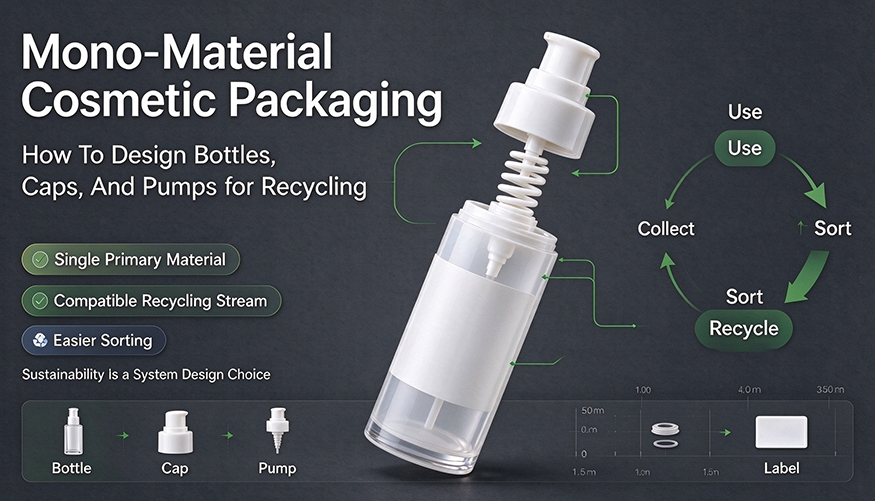
A skincare bottle may look simple on the outside, but its packaging can contain several different materials. The bottle might be made from PET or glass, while the cap uses PP, the pump contains PE components, and a metal spring sits inside the dispensing mechanism.
This combination can create challenges at the end of the product's life. When packaging contains multiple materials that are difficult to separate, sorting and recycling become more complicated. Small components, mixed-material structures, decorative coatings, and incompatible labels can also affect recycling efficiency.
For cosmetic brands, packaging sustainability is no longer just about choosing a recyclable bottle. It is about designing the entire packaging system—including the bottle, cap, pump, label, and other components—with material recovery in mind.
One increasingly important approach is mono-material cosmetic packaging: using one primary material, or compatible materials within the same recycling stream, wherever practical.
Mono-material packaging is designed to minimize the use of incompatible materials within a packaging component or system, making material identification, sorting, and recycling easier.
For cosmetic packaging, this may mean selecting a PET bottle with a compatible PET closure, a PE tube with a compatible PE cap, or a PP container designed around a compatible PP component system.
However, mono-material does not automatically mean fully recyclable. The complete design still matters, including labels, adhesives, colorants, coatings, component size, and the recycling infrastructure available in the target market.
A package made from several materials may also be recyclable if its components can be separated efficiently and the relevant materials are collected and processed locally.
The objective is not simply to reduce the number of materials. It is to make the package easier to recover as a useful material after use.
A PET bottle with a PP cap contains two different plastics. Depending on the local recycling system and package design, the bottle and cap may need to be separated or processed differently.
The same issue can arise with a PE tube, a different-material cap, a multilayer barrier structure, or a bottle fitted with a complex pump.
When components are difficult to separate, the package may be less suitable for the recycling processes available in a particular market.
Lotion pumps and mist sprayers can include a plastic actuator, housing, closure, dip tube, seals, and a metal spring. Some designs also use multiple polymer types.
These components help the package dispense the formula, but their combination can complicate material recovery.
For brands seeking more recyclable packaging, useful design questions include:
Can the pump be simplified without compromising dispensing performance?
Can compatible polymer materials be used across more components?
Can metal parts be removed or reduced where technically feasible?
Can the pump be separated from the bottle easily?
Is the complete package compatible with the recycling stream in the target market?
A pump should not be judged solely by the number of materials it contains. Its size, separability, construction, and compatibility with actual recycling processes also matter.
A recyclable bottle resin does not guarantee that the decorated package will be recyclable.
Large labels, incompatible adhesives, metallic finishes, heavy coatings, and certain inks may interfere with sorting or recycling, depending on the material combination and process.
Packaging designers should therefore consider decoration at the beginning of development—not after the bottle and closure have already been finalized.
European packaging legislation is increasing the focus on recyclability, recycled content, packaging minimization, and clearer waste sorting.
Two important regulations are the Single-Use Plastics Directive (SUPD) and the Packaging and Packaging Waste Regulation (PPWR). They have different scopes and should not be treated as interchangeable.
Since July 3, 2024, the EU's Single-Use Plastics Directive has required plastic caps and lids to remain attached to certain single-use beverage containers with a capacity of up to three liters during their intended use. The requirement is intended to help keep caps together with the containers and reduce litter. It does not establish a general tethered-cap requirement for cosmetic bottles.
Official guidance: EU rules on single-use plastics.
The broader lesson for cosmetic packaging is that small components matter. Designing caps, closures, and dispensing systems for effective collection and material recovery can help support a more circular packaging system, even where a specific beverage-packaging rule does not apply.
The EU Packaging and Packaging Waste Regulation (Regulation (EU) 2025/40) entered into force on February 11, 2025, and began applying generally on August 12, 2026.
The regulation establishes a broader framework covering packaging design, recyclability, recycled plastic content, packaging minimization, reuse, and labeling. Its requirements are phased, and specific obligations may have their own implementation dates.
The PPWR aims to make packaging recyclable in an economically viable way by 2030. It also establishes minimum recycled-content requirements for specified categories of plastic packaging, with targets generally beginning in 2030 and increasing for 2040. The applicable target depends on the packaging category and its use.
For example, Article 7 includes separate recycled-content targets for contact-sensitive PET packaging, contact-sensitive packaging made from other plastics, single-use plastic beverage bottles, and other plastic packaging. Cosmetic packaging requirements should therefore be assessed against the specific category and applicable provisions rather than assuming one recycled-content percentage applies to every bottle.
Official references:
For cosmetic brands exporting to Europe, the practical step is to review packaging design, material composition, documentation, and the applicable compliance timeline early in product development.
Using compatible materials across the bottle and closure can simplify the packaging design.
Examples include:
PET bottle with a compatible PET closure
PE tube with a compatible PE cap
PP container with compatible PP components
These combinations are starting points, not automatic guarantees of recyclability. The closure design, additives, labels, adhesives, colorants, and local recycling infrastructure must also be considered.
For PET bottles in particular, a PP cap may still be compatible with some established recycling processes when the package is designed appropriately. Changing every closure to PET is not necessarily the best solution for every application.
Pumps and sprayers are often among the most technically complex parts of cosmetic packaging.
To improve their end-of-life performance, packaging developers can evaluate:
Reducing unnecessary component complexity
Using compatible polymer materials where feasible
Reducing or eliminating metal components when a validated alternative is available
Designing components for easier separation
Checking whether the complete dispensing system is accepted by relevant recycling processes
These changes must be balanced against formula compatibility, leakage prevention, dispensing accuracy, consumer usability, and production requirements.
For example, removing a metal spring may be attractive from a material-simplification perspective, but a replacement design must still provide reliable performance with the intended formula.
Labels are a small part of the package by weight, but they can affect sorting and recycling.
When developing a recyclable cosmetic bottle, consider:
Label materials compatible with the intended recycling stream
Adhesives suitable for the relevant recycling process
Label size and coverage
Easy separation or removal where appropriate
Avoiding unnecessary metallic films and incompatible decorative layers
The correct solution depends on the bottle material and the recycling process. A label suitable for a PET bottle may not be suitable for a PE container, so the complete combination should be assessed.
Premium appearance and recyclability can coexist, but decoration should be evaluated carefully.
Instead of adding multiple layers of materials, brands can explore options such as restrained printing, compatible colorants, simplified coatings, and lighter packaging structures.
The aim is to retain the desired brand presentation while reducing features that may interfere with sorting or material recovery.
A bottle labeled PET, PP, or PE is not automatically recyclable in every market.
Before finalizing a design, evaluate the complete package—including the bottle, closure, pump, label, adhesive, coating, and any metal parts—against the intended collection and recycling system.
Where relevant, request technical documentation or recyclability assessments based on recognized design-for-recycling guidelines. Confirm whether the packaging can be collected, sorted, and processed at scale in the markets where it will be sold.
Not necessarily. Mono-material design is an important strategy, but it must be balanced with the product's functional requirements.
For example, a skincare formula may require a barrier structure, a precise dispensing mechanism, or a closure that meets specific leakage and safety requirements. A single-material design may not meet those requirements without additional development.
In these cases, a carefully engineered multi-material package with separable components may be more practical than a nominally mono-material package that performs poorly or cannot be processed by local recycling systems.
The best design is the one that balances product protection, manufacturing feasibility, consumer use, and verified end-of-life performance.
At BEYAQI, sustainable packaging development starts with the complete packaging structure rather than a single component. Bottle material, closure design, pump construction, decoration, and filling requirements all influence the final solution.
For skincare and personal care brands, potential design approaches include exploring compatible material combinations, simplifying closures and dispensing systems, and reviewing decoration choices to support recyclability goals.
The right solution depends on the formula, required dispensing performance, target market, and available recycling infrastructure. Reviewing these factors early can help brands make better-informed decisions before moving into tooling and mass production.
When discussing a recyclable packaging project, share the intended bottle material, closure or pump type, decoration requirements, target sales markets, and any relevant sustainability or regulatory criteria. These details provide a stronger starting point for evaluating feasible packaging options.
Mono-material cosmetic packaging is designed to minimize incompatible materials within a package or component system. It can simplify sorting and recycling, but recyclability still depends on the complete design and the recycling infrastructure available.
It may be recyclable, depending on the bottle and cap design and the recycling system. Some established PET recycling processes can accommodate compatible PP closures, while other designs or local systems may require separation. Check the complete package rather than relying on resin names alone.
Metal springs can complicate material recovery when they are difficult to separate from the pump. However, their impact depends on the pump's construction and the recycling process. Brands can evaluate simpler or alternative designs where performance requirements allow.
No. The PPWR establishes broader requirements concerning packaging recyclability and other environmental criteria; it does not mean that every cosmetic package must be made from one material. Specific compliance depends on the applicable provisions, packaging design, and implementation timelines.
Review the complete package: bottle, cap, pump, seals, labels, adhesives, coatings, and any metal parts. Consider local collection and recycling systems, formula compatibility, product protection, and relevant regulatory requirements.
Designing recyclable cosmetic packaging requires more than choosing a recyclable resin. By simplifying unnecessary complexity, selecting compatible materials, and validating the complete package, brands can make more practical progress toward packaging that supports effective material recovery.


 English


