Views: 105 Author: Site Editor Publish Time: 2026-10-21 Origin: Site
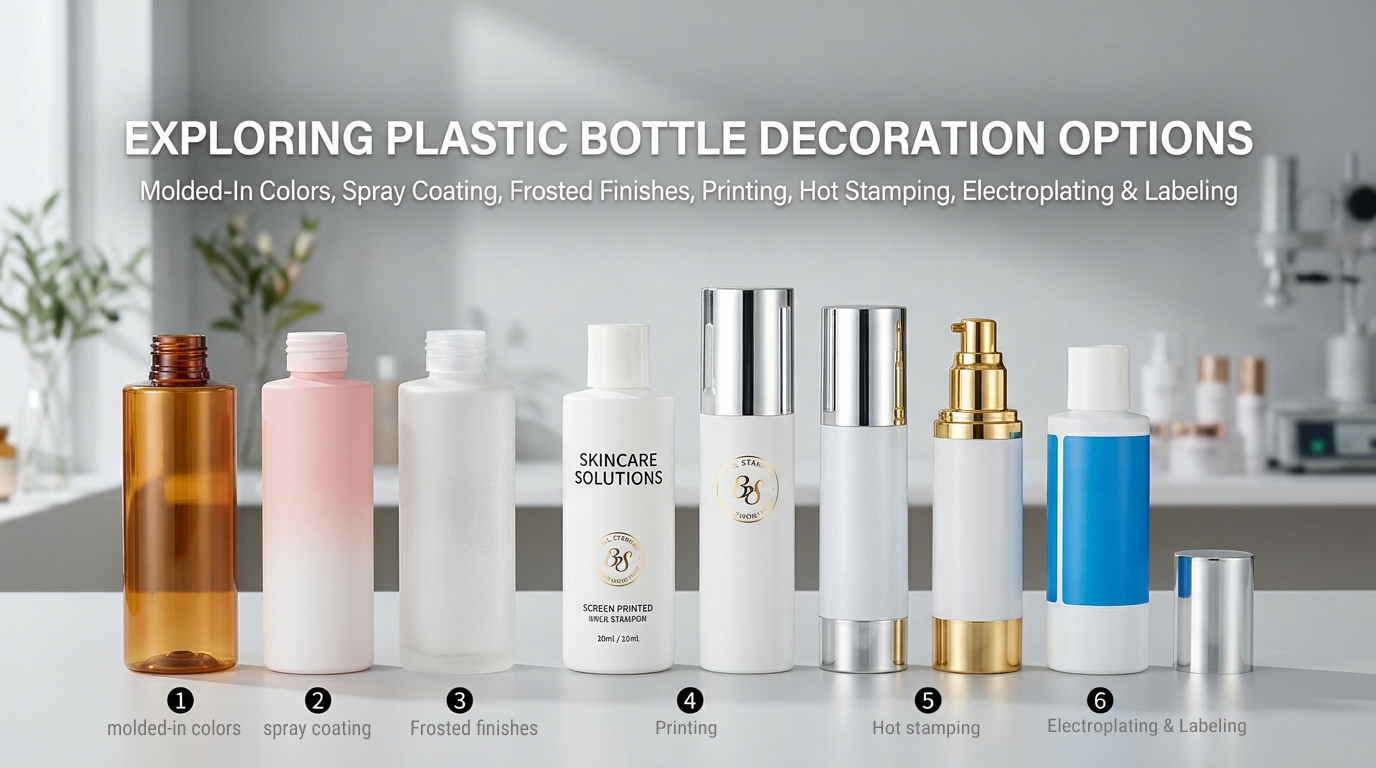
When selecting plastic bottles for skincare, makeup, and personal care products, one of the first questions buyers ask is: What decoration options are available?
Plastic cosmetic packaging can be customized in many ways, from molded-in colors and spray coatings to screen printing, hot stamping, electroplating, and labeling. Each technique creates a different visual effect and comes with its own material requirements, production considerations, and cost implications.
However, not every decoration method is suitable for every bottle. PET, PETG, PP, PE, and ABS differ in their optical properties, surface characteristics, heat resistance, and manufacturing processes. The final result also depends on the bottle shape, decoration area, production volume, and quality requirements.
One of the most direct ways to customize plastic packaging is to introduce color during material processing or preform production, depending on the manufacturing method.
Common appearance options include:
Transparent and translucent colors
Solid colors
Milky white
Amber and tea tones
Pearl effects
Two-tone designs
Different colors in the upper and lower sections, where the production process allows
For PET and PETG bottles made through preform-based blow molding, color is often controlled at the preform stage. Consistent color preparation and processing help support a uniform appearance in the finished bottle.
However, the final color is influenced by more than the colorant itself.
Bottle thickness, geometry, transparency, background, and lighting can all affect how the color appears. A translucent amber bottle, for example, may look different when viewed through a thin sidewall versus a thick base.
Pearlescent, translucent, and tinted effects should therefore be evaluated using physical samples rather than relying exclusively on digital color references.
Best for: Brands seeking integrated color, a clean finish, or a distinctive appearance without relying entirely on surface coatings.
Spray coating is widely used to change the color, gloss, and tactile feel of plastic cosmetic bottles.
Depending on the coating system, available finishes may include:
Glossy coatings
Matte coatings
Gradient colors
Soft-touch coatings
Rubberized-feel coatings
Frosted-look coatings
Metallic-effect coatings
A clear PET bottle, for example, can take on a very different visual identity after a matte or gradient coating is applied. Soft-touch coatings can also provide a more tactile surface.
The actual result depends on the coating formulation, substrate, surface preparation, and application conditions.
Coating can increase material and processing costs and may introduce additional production loss. Larger coated areas, complex gradients, special tactile effects, and demanding appearance standards can require more process control.
Quality checks should consider:
Color consistency
Dust particles and surface contamination
Runs, drips, or uneven coverage
Scratches and abrasion
Coating adhesion
Consistency across production batches
Where the bottle will be transported over long distances or handled frequently, coating durability should be evaluated under relevant conditions.
Best for: Brands that want to change the bottle's color, reduce gloss, introduce gradients, or create a distinctive tactile finish.
Frosted cosmetic packaging is popular among brands seeking a soft, understated, or minimalist appearance.
Sandblasting uses controlled abrasive treatment to modify a suitable surface, creating a texture that scatters light and reduces the strong reflections of a glossy finish.
The final effect depends on several factors:
Texture intensity
Surface uniformity
Remaining transparency
Tactile feel
Bottle geometry
A finer texture may create a subtle, delicate frosted appearance, while a more pronounced texture can produce stronger haze and a more noticeable surface feel.
However, stronger frosting is not necessarily better. Excessive or uneven treatment can make a bottle look cloudy or grayish and reduce the visibility of the formula.
It is also important to distinguish a frosted finish from a specific manufacturing method. A frosted appearance may be achieved through suitable material selection, mold texturing, abrasive treatment, or matte coating. These methods are not interchangeable in every application.
Material suitability should be confirmed before processing, especially for plastic bottles with complex shapes or demanding optical requirements.
Best for: Skincare and personal care packaging that requires a softer visual effect, reduced gloss, or a translucent frosted appearance.
Printing and stamping allow brands to apply logos, product information, graphics, and decorative accents directly to packaging components.
Common options include:
Screen printing is frequently used for brand names, simple graphics, and product information. It can be suitable for a range of bottle shapes, subject to the printing equipment, surface geometry, and ink system.
Pad printing transfers ink using a flexible pad and can be useful for certain small graphics or areas that are difficult to access with other methods. Its suitability depends on the shape, size, and detail of the design.
UV printing uses ultraviolet curing to solidify ink. Depending on the equipment and application, it can support colorful graphics and detailed artwork.
Hot stamping transfers decorative foil to a suitable surface, creating metallic or other specialized effects. Gold and silver are common choices, but the available appearance depends on the foil and substrate.
Some designs use contrasting gloss and matte areas to create visual depth without adding multiple colors.
Unlike flat paper, cosmetic bottles have curved or irregular surfaces. Printing area, bottle rotation, mold parting lines, and alignment tolerances can all affect the result.
Large-area stamping, wraparound printing, fine text, and artwork close to a parting line may require additional development and testing.
Brands should confirm the actual printed sample, including artwork position and registration, rather than judging feasibility from a flat design file alone.
Best for: Branding, product information, logos, decorative accents, and designs that require controlled graphic placement.
Plastic packaging components can be given metallic appearances through suitable electroplating or other metallic finishing processes.
These effects are commonly used on:
Caps
Shoulder pieces
Outer covers
Pump housings
Decorative components
Typical appearance options include bright gold, silver, rose gold, gunmetal, and champagne gold.
The final finish depends on the substrate, pretreatment, coating or plating system, component geometry, and process control.
Metallic finishing requires attention to surface quality, cleanliness, dimensional consistency, and the requirements of subsequent assembly.
Potential quality concerns include scratches, coating damage, adhesion problems, discoloration, and visible fingerprints. Contact points between components may also require attention if friction could damage the finish.
A sample that looks excellent immediately after production does not automatically guarantee the same appearance after packaging, transportation, and repeated handling.
Best for: Caps, pump housings, covers, and decorative components where a metallic accent supports the product's visual identity.
Direct printing is not the only way to customize a plastic bottle. Labels and decorative components can offer additional flexibility, particularly for designs with extensive graphics or variable product information.
Common options include:
Pressure-sensitive adhesive labels
Transparent labels
Pearlescent film labels
Metallic labels
Inlaid or embedded decorative elements
Shrink-sleeve labels
Adhesive labels can accommodate detailed graphics and product information. Their performance depends on the adhesive, label material, bottle surface, and application conditions.
Transparent labels can create a printed-directly-on-the-bottle appearance, but the effect depends on label clarity, adhesive appearance, surface texture, and the contrast between the graphics and the formula.
Metallic labels and inlaid decorative parts can create a distinctive visual effect, but may require additional components, assembly steps, and cost.
Shrink sleeves can cover a larger portion of the container and accommodate extensive graphics. Suitability depends on the bottle geometry, sleeve material, shrinking conditions, and required appearance.
Bottle curvature, surface texture, coating, adhesive selection, and storage or transportation temperatures can influence label adhesion.
For frosted or coated bottles, brands should confirm that the label adheres reliably to the actual surface. Checks may include edge lifting, bubbles, wrinkles, and adhesion after relevant environmental exposure.
Best for: Products requiring detailed artwork, extensive information, flexible graphic changes, or decorative effects that are difficult to achieve through direct printing alone.
Not every cosmetic packaging component is made through blow molding.
Caps, cream jars, shoulder pieces, outer shells, and many multi-part components are commonly produced through injection molding.
Depending on the design and material, injection molding can support:
Thick-wall components
Double-layer structures
Two-color designs
Transparent outer shells
Inner liners or inserts
Snap-fit structures
Threads and precision-fitting features
Complex decorative components
Injection molding is particularly useful when packaging requires defined geometry, dimensional control, and coordinated component assembly.
For example, a thick-wall cream jar or a double-layer outer shell may require injection-molded components rather than a conventional blow-molded bottle structure.
However, complex structures can require additional tooling investment, more demanding assembly controls, and higher production costs.
The final design should balance the desired appearance and functionality with mold feasibility, material selection, manufacturing yield, and target order volume.
Best for: Cream jars, caps, thick-wall packaging, multi-layer structures, and components requiring precise fit or integrated decorative details.
Yes. Several decoration techniques can be combined to create a distinctive cosmetic packaging design, but every additional process introduces another set of compatibility and quality considerations.
Examples include:
Spray coating followed by screen printing
Sandblasting combined with labeling
Dark-colored bottles with hot-stamped logos
Metallic-plated components assembled with other plastic parts
Gradient coatings combined with printed graphics
Before combining processes, brands should check the interaction between each finish and the next manufacturing step.
For example, printing ink must adhere properly to the selected coating. Labels need a suitable bonding surface. Hot stamping requires appropriate contact conditions, and plated components should be evaluated at areas where parts may rub against each other.
Combining multiple techniques can also increase setup time, process complexity, inspection requirements, and production loss.
More decoration does not automatically mean better packaging. The most effective design is one in which the material, bottle shape, color, finish, and branding elements work together.
Before confirming a decoration process, brands should evaluate three core factors.
Identify the actual plastic material and confirm whether it is suitable for the intended process. PET, PETG, PP, PE, and ABS may respond differently to coatings, inks, adhesives, and surface treatments.
Do not assume that a process validated on one material will deliver the same result on another.
Define the intended finish as clearly as possible. Is the goal to create a transparent appearance, a soft matte surface, a metallic accent, a gradient, or detailed branding?
Physical samples and finish references help translate subjective terms such as “premium,” “soft-touch,” and “high-gloss” into practical specifications.
A decoration technique must work not only on a sample but also under actual production conditions.
Consider the following before approval:
Minimum order quantity and setup costs
Production lead time
Expected process loss
Decoration adhesion and durability
Visual consistency across batches
Compatibility with filling, assembly, packaging, and transportation
A practical development process should include sample evaluation and appropriate testing before the final specification is approved for mass production.
Plastic cosmetic bottles offer a wide range of customization options, from molded-in colors and spray coatings to sandblasting, printing, hot stamping, metallic finishes, labels, and injection-molded structures.
Each technique serves a different purpose. Some change the bottle's color or surface texture, while others add branding, decorative details, or structural functionality.
The right choice depends on the material, bottle geometry, desired appearance, target cost, order quantity, and production requirements.
At BEYAQI, we help brands evaluate cosmetic packaging formats and decoration options with attention to design intent, material compatibility, and manufacturing feasibility. By confirming the finish through samples and evaluating its performance before mass production, brands can develop packaging that looks distinctive and remains consistent at scale.


 English


